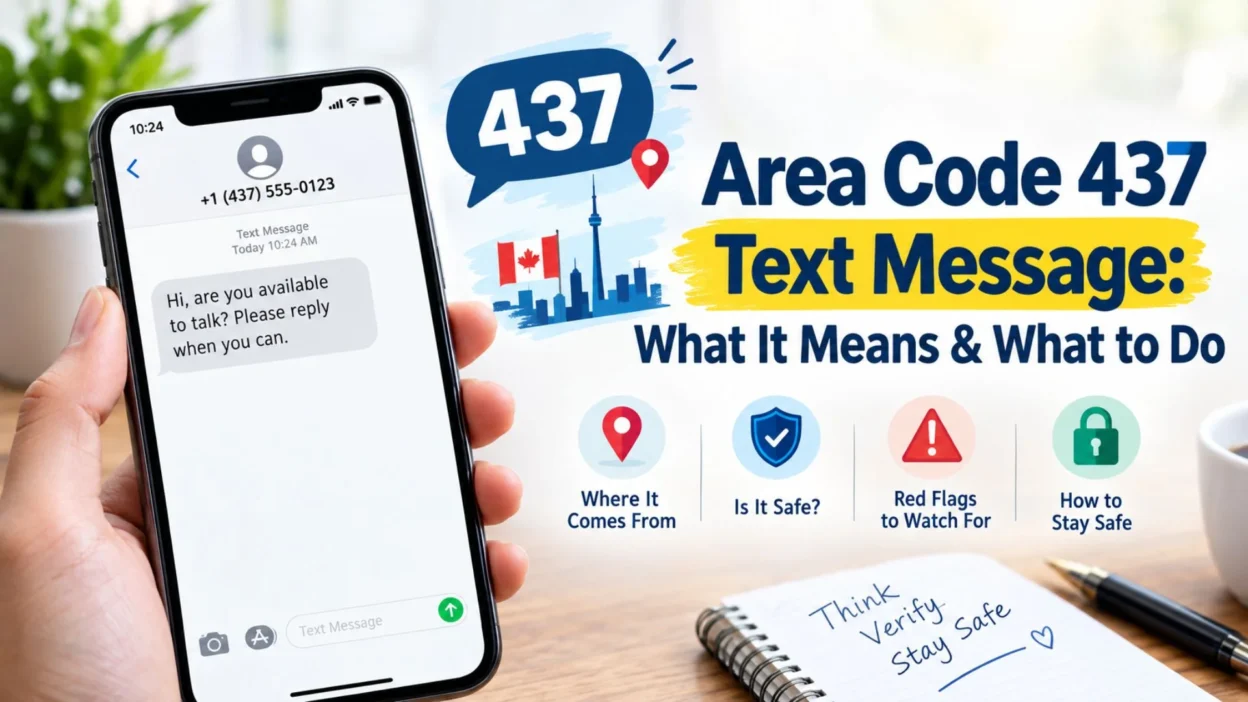
Getting an unexpected text can make you wonder who sent it and why they have your number. If the message starts with a 437 area code, you may immediately ask whether it is from someone in Toronto or whether it could be spam.
An area code 437 text message does not automatically mean the message is a scam. The 437 area code is a legitimate Toronto, Ontario, Canada telephone code. However, scammers can use or spoof phone numbers, so the area code alone cannot prove who is behind a message. Recent public reports include unwanted and suspicious texts from numbers beginning with 437, including messages involving fake deliveries, payment requests, and attempts to get recipients to respond.
The safest approach is to look at the content of the message, especially if it asks for personal information, money, login details, or urgent action.
Top Area Code 437 Text Message Examples
These examples reflect common situations people may encounter when receiving an unexpected message from a 437 number. They are useful for recognizing the type of message rather than identifying any particular sender.
- “Hi, is this still your number?”
- “Hey, I think I may have the wrong number. Sorry!”
- “Hello, are you available to talk?”
- “We noticed an issue with your recent account activity.”
- “Your package delivery needs your attention.”
- “Please confirm your delivery information.”
- “Your appointment is scheduled for tomorrow.”
- “Can you confirm that you received this message?”
- “Hi, I wanted to ask you something.”
- “We tried reaching you earlier. Please respond when you can.”
- “Your account requires verification.”
- “There is an update regarding your recent request.”
- “Please review the information in your account.”
- “Your delivery could not be completed.”
- “A payment notification is waiting for you.”
- “Please contact us regarding your recent transaction.”
- “Your reservation details have changed.”
- “We need to confirm some information with you.”
- “You have a new notification regarding your account.”
- “Can you reply when you get a chance?”
Short Area Code 437 Text Messages
Short messages can look harmless, but an unfamiliar sender should still be treated carefully. A genuine-looking message can be difficult to verify from the area code alone.
- “Hi, is this you?”
- “Hello, can we talk?”
- “Are you available?”
- “Please reply when free.”
- “Can you confirm this?”
- “Is this still your number?”
- “We need to reach you.”
- “Your delivery is waiting.”
- “Please check your account.”
- “Can you verify this?”
- “Important account update.”
- “Your appointment changed.”
- “Please review this notice.”
- “Can you call us back?”
- “Your package needs attention.”
- “We tried contacting you.”
- “Please respond when available.”
- “There is an update for you.”
- “Can you confirm your details?”
- “Please check the latest notification.”
Best Area Code 437 Text Message Tips for Sharing
If you are explaining an unexpected 437 message to someone else, keep the advice simple: the area code is not enough to establish whether a message is trustworthy. Area code 437 legitimately serves Toronto, but phone numbers can be spoofed or used by people outside the area.
- “A 437 number is associated with Toronto, but the area code alone does not identify the sender.”
- “An unexpected 437 text does not automatically mean it is a scam.”
- “Check the message carefully before responding to an unfamiliar 437 number.”
- “Never trust a message simply because the number looks local.”
- “If a text creates urgency, pause and verify it independently.”
- “Be especially careful when an unknown text asks for personal information.”
- “A familiar-looking area code does not guarantee that the sender is genuine.”
- “If you do not recognize the number, avoid sharing private information.”
- “Check the full phone number and message context before deciding how to respond.”
- “Unexpected texts deserve extra attention when they include links or payment requests.”
- “If a message claims to represent a company, verify it through the company’s official contact information.”
- “Do not assume a 437 text came directly from Toronto just because the number uses that area code.”
- “Keep suspicious messages until you have finished reporting them, if needed.”
- “Your safest response to a suspicious message may be no response at all.”
- “When something feels unusual, verify it through an independent source.”
One-Line Area Code 437 Text Message Reminders
- Area code 437 belongs to Toronto, Ontario, Canada.
- A 437 number can be legitimate, but the area code does not prove the sender’s identity.
- Unexpected messages should be checked carefully before you respond.
- Never share sensitive information with an unknown sender.
- Be cautious when an unfamiliar text contains a link.
- Urgency is a reason to pause and verify, not rush.
- A local-looking number can still be misleading.
- Check the full number instead of relying only on the area code.
- If you do not recognize the sender, avoid giving them personal details.
- Verify business messages through an official website or known contact method.
- A 437 text message can come from a real person, business, or unwanted sender.
- The area code alone cannot tell you whether a message is trustworthy.
- When in doubt, do not click first—verify first.
- Save important evidence before deleting a suspicious message.
- Protect your personal information when dealing with unfamiliar texts.
Best Area Code 437 Text Message Responses
When an unfamiliar 437 number contacts you, the right response depends on the situation. If you do not recognize the sender, there is no need to provide personal details just to find out who they are.
- “Hi. May I ask who this is?”
- “I don’t recognize this number. Who are you trying to reach?”
- “Could you please identify yourself and explain why you’re contacting me?”
- “I’m not familiar with this number. Please provide more context.”
- “Before I respond, can you tell me who you represent?”
- “I don’t share personal information through unexpected text messages.”
- “Please contact me through an official channel if this concerns an account.”
- “I’ll verify this information independently before taking any action.”
- “I don’t recognize this message, so I won’t be clicking the link.”
- “Please send the details through the official customer service channel.”
- “I believe you may have the wrong number.”
- “Sorry, I don’t know anyone using this number.”
- “Please remove my number from your contact list.”
- “I’m not interested. Please do not contact me again.”
- “I won’t provide account or payment information by text.”
- “If this is a legitimate business matter, I’ll contact the company directly.”
- “I’m going to verify this request before responding.”
- “Thanks, but I don’t respond to unexpected requests for personal information.”
- “I don’t recognize the sender, so I’m choosing not to continue this conversation.”
- “Please do not send additional messages to this number.”
How to Tell If a 437 Text Message Looks Suspicious
The area code itself is not a reliable way to determine whether a message is genuine. Instead, look at what the sender is asking you to do.
A suspicious text may create pressure, request sensitive information, or direct you toward an unfamiliar website. These signs do not prove that a message is fraudulent, but they are useful reasons to stop and verify the claim independently.
- The sender asks for your password or login information.
- The message requests a verification code that you did not request.
- The sender asks for banking or payment information.
- The message contains an unexpected link.
- The sender creates unusual urgency.
- You are told that something bad will happen unless you act immediately.
- The message claims you won a prize you never entered to win.
- You are asked to send money or cryptocurrency.
- The sender asks you to download an unfamiliar app or file.
- The message uses a business name but does not provide a verifiable way to contact that business.
- The sender claims there is an account problem but you cannot find the same notice through the company’s official website or app.
- The message contains unusual spelling, awkward wording, or inconsistent branding.
- You are asked to keep the conversation secret.
- The sender wants personal information that does not seem necessary for the stated purpose.
- The message asks you to move the conversation to another platform immediately.
What to Do After Receiving an Area Code 437 Text Message
If you receive an unexpected message from a 437 number, take a moment before responding. Since 437 is a legitimate Toronto area code, the number itself does not establish whether the sender is genuine.
- Read the entire message: Look at what the sender actually wants from you.
- Check the number: If you recognize the person or organization, compare the number with information you already have.
- Avoid unexpected links: Do not open links simply because the message says they are urgent.
- Do not share sensitive information: Keep passwords, verification codes, financial information, and other private details out of unexpected text conversations.
- Verify independently: If the message claims to be from a company, use its official website or a trusted contact method instead of the information supplied in the text.
- Do not rush: A message demanding immediate action deserves additional scrutiny.
- Block unwanted senders: If the message is clearly unwanted, blocking the number can stop further texts from that number.
- Report suspicious messages: Your mobile carrier or relevant authorities may provide reporting options for unwanted or fraudulent messages.
- Keep records when necessary: If a message appears threatening, fraudulent, or otherwise important, keep a copy before deleting it.
- Ask someone you trust: If you are unsure about a suspicious message, showing it to a trusted person can provide another perspective.
Area Code 437 Text Message Captions
These short captions can be useful when sharing general information about an unexpected 437 text message on social media or with friends.
- “Got an unexpected 437 text? Check the message, not just the area code.”
- “A local-looking number does not automatically mean a trusted sender.”
- “Unknown text? Pause, verify, then decide whether to respond.”
- “When a text asks for private information, take a moment to verify it.”
- “Area code 437 is associated with Toronto, but numbers alone do not tell the whole story.”
- “Unexpected message? Don’t let urgency make the decision for you.”
- “Think before you click an unfamiliar text link.”
- “A suspicious text is worth checking before replying.”
- “Protect your information, even when a message looks convincing.”
- “Unknown number, unexpected request? Verify it first.”
- “The safest text response can sometimes be no response.”
- “Don’t judge a message by its area code alone.”
Copy-Paste Ready Area Code 437 Text Message Replies
If you simply want a quick response for an unfamiliar sender, these messages are easy to copy and personalize.
- “Hi, I don’t recognize this number. Could you please tell me who this is?”
- “Hello. Before I continue, could you explain who you are and why you’re contacting me?”
- “I’m not comfortable sharing personal information through an unexpected text. Thank you.”
- “I believe you may have the wrong number. Please check your contact details.”
- “I don’t recognize this request. I’ll verify it through an official source first.”
- “If this message is regarding an account, I’ll contact the company directly using its official information.”
- “I won’t click unfamiliar links. Please provide another way to verify this request.”
- “Thanks for reaching out, but I don’t respond to unexpected requests for personal information.”
- “I don’t know this number, so I’m going to end the conversation here.”
- “Please do not contact this number again.”
What Does Area Code 437 Mean?
Area code 437 is a Canadian telephone area code serving Toronto, Ontario. It was introduced as an overlay for the existing Toronto numbering area, meaning 437 numbers can exist alongside other Toronto area codes rather than representing a completely separate geographic region.
Because phone numbers can be assigned, transferred, or spoofed, seeing 437 on your screen does not necessarily tell you where the person sending the message is physically located.
That is why it is better to consider the content and context of the text rather than treating the area code as proof that a message is legitimate or suspicious.
FAQ About Area Code 437 Text Message
Is area code 437 a real area code?
Yes. 437 is a legitimate Canadian area code associated with Toronto, Ontario. It operates as an overlay with other Toronto area codes, including 416 and 647.
Is an area code 437 text message always a scam?
No. A text from a 437 number is not automatically a scam. The sender could be a legitimate person or organization. However, scammers can also use phone numbers that appear local, so the area code alone cannot establish who sent the message.
Why did I receive a text from a 437 number?
There are several possibilities. Someone you know may have a 437 number, a business may be contacting you, the sender may have the wrong number, or the message could be unwanted or fraudulent.
Should I reply to an unknown 437 number?
If you do not recognize the sender, consider not replying until you understand who is contacting you and why. Be particularly cautious if the message requests money, passwords, verification codes, personal information, or asks you to click an unexpected link.
What should I do if a 437 text seems suspicious?
Avoid clicking links or sharing sensitive information. Instead, verify any claimed business or account issue through an official website, app, or trusted contact method. You can also block or report unwanted messages through the options available on your phone or with your carrier.
Final Thoughts
An area code 437 text message can be completely ordinary, but an unfamiliar message deserves a little attention before you respond. Since 437 is a legitimate Toronto area code, seeing it on your phone does not automatically identify the sender or establish whether the message is trustworthy.
The most useful thing to remember is simple: look beyond the area code. Consider the wording, the sender’s request, any links included in the message, and whether the situation makes sense. If someone claims to represent a company, verify that claim using contact information you find independently.
You do not need to respond immediately to an unexpected text. Taking a moment to check the details can help you avoid sharing information with the wrong person or following an unsafe request.
Whether you received a simple “hello,” a delivery notice, or an unexpected account alert, use the context of the message to decide what to do next. When a text feels uncertain, pause, verify, and protect your information first.

Ryan Mitchell is a professional content writer who specializes in creating heartfelt messages, wishes, greetings, and inspirational quotes for every occasion. He is passionate about helping readers express their thoughts and emotions through meaningful, engaging, and easy-to-share content.