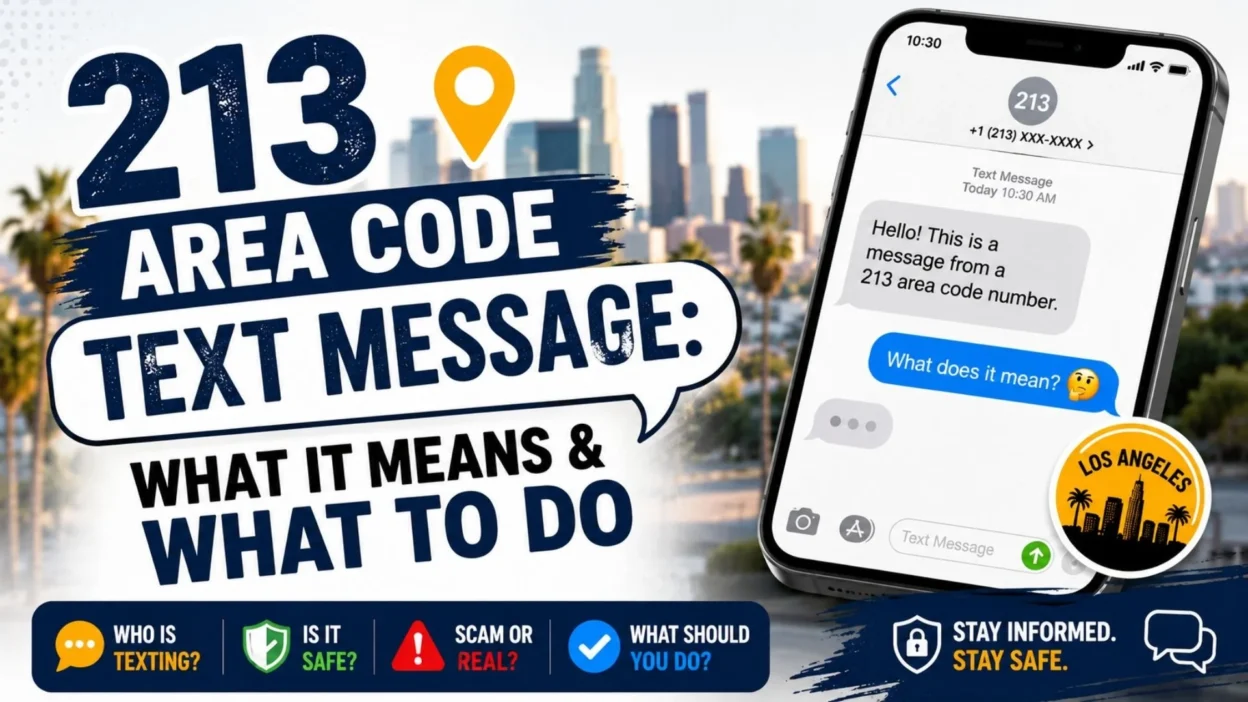
Getting an unexpected message from a 213 number can make you wonder who is behind it. You might recognize the Los Angeles connection, or you may have no idea why someone with a 213 number is contacting you. In either case, it is worth checking the situation before replying.
A 213 area code text message can come from a real person, business, service, or an unwanted sender. The 213 area code is a legitimate California code associated with Los Angeles and nearby communities. However, scammers can also spoof local-looking numbers, so the area code alone cannot confirm that a message is genuine.
This guide explains what the 213 area code means, why you might receive a text from it, and which warning signs deserve attention. You will also find simple ways to handle an unfamiliar message without rushing into a reply.
What Is the 213 Area Code?
The 213 area code is associated with Los Angeles, California, particularly downtown Los Angeles and surrounding communities. It is one of California’s original area codes, established in 1947. Today, the 213 region operates alongside overlay area codes including 323 and 738.
Because 213 is a genuine local area code, receiving a message from one does not automatically mean something is wrong. A person who lives in the Los Angeles area may legitimately have a 213 number. Businesses, organizations, and service providers can also use numbers with this area code.
However, there is an important distinction: an area code identifies the numbering area associated with a phone number, not necessarily the current physical location of the person using it. In addition, spoofing can make an incoming message appear to come from a number that the sender does not actually control.
Why Did I Get a 213 Area Code Text Message?
There are several possible explanations. Not every unexpected text has the same meaning, so consider the context before deciding how to respond.
A Real Person May Be Contacting You
The simplest explanation is often that someone with a 213 number is trying to reach you.
For example, the sender could be:
- A person you know who recently changed numbers 📱
- A local business you have interacted with
- A service provider following up on a request
- Someone who entered the wrong number
- An organization contacting you about an existing account
If the message clearly relates to something you recently requested or expected, it may be legitimate. Still, verify important information independently when the message asks you to take action.
It Could Be a Wrong-Number Text
Wrong-number messages are another possibility.
Someone may send a casual message because they believe they are contacting another person. If you do not recognize the sender, you do not need to continue the conversation simply because the message sounds friendly.
A strange or unexpected conversation can sometimes begin with a harmless-looking greeting. Security-focused sources have specifically warned about generic opening texts being used to start longer scam conversations.
It Could Be Spam or a Scam
Some unwanted messages use local-looking numbers to appear more familiar. A 213 number can therefore look convincing even when the sender is not actually located in Los Angeles.
Be especially cautious when an unfamiliar message:
- Creates urgency or pressure
- Requests personal information
- Asks for passwords or verification codes
- Requests money or payment
- Includes an unexpected link
- Claims there is a problem with an account
- Promises a prize or financial opportunity
- Pushes you to continue the conversation on another platform
A local-looking number should never be treated as proof that a message is trustworthy.
Is a 213 Area Code Text Message a Scam?
Not necessarily. The 213 area code itself is legitimate, so you should not assume that every message from a 213 number is fraudulent.
The important question is whether the message makes sense and whether you can independently verify the sender.
For instance, suppose a message claims to be from a company you already use. Instead of clicking a link inside the message, open the company’s official website or use contact information you already know. That gives you a safer way to check whether the message is real.
Likewise, if someone claims to know you but you do not recognize the number, avoid sharing personal details just to confirm their story.
Remember that spoofing can make a phone number appear local or familiar even when the sender is somewhere else.
Common Warning Signs to Watch For
A suspicious message usually becomes easier to recognize when you look at its behavior rather than its area code.
Unexpected Links 🔗
An unfamiliar sender may encourage you to click a link to solve an urgent problem, claim a reward, confirm an account, or check a delivery.
Do not click unexpected links simply because the message appears to come from a local number.
Requests for Personal Information
Be careful if a stranger asks for information such as:
- Passwords
- Account login details
- Security codes
- Banking information
- Home address
- Other private details
A legitimate organization generally gives you safer ways to verify an account rather than relying on an unexpected text.
Pressure to Act Quickly
Urgency is another useful warning sign.
Messages that say you must act immediately, pay right away, or provide information before a deadline may be trying to prevent you from thinking carefully.
Take a moment to verify the claim instead.
A Conversation That Feels Unusually Personal
Some unwanted messages begin with a simple greeting and gradually try to build familiarity. A conversation that quickly becomes strange, secretive, or financially focused deserves extra caution.
What Should You Do With an Unknown 213 Text?
If you do not recognize the sender, you do not have to respond immediately.
A sensible approach is to pause, read the message carefully, and consider whether you were actually expecting contact. If the message contains a suspicious link or asks for sensitive information, avoid interacting with it.
For important claims, verify them through an official channel you find independently rather than using contact details supplied inside the unexpected text.
You can also use your phone’s built-in spam controls to block or report unwanted messages. In the United States, suspicious unwanted texts can also be forwarded to 7726 (SPAM), a reporting option referenced by consumer-safety guidance.
Most importantly, do not let the familiar-looking 213 area code make the decision for you. The content and context of the message matter much more than the first three digits.
How to Check a 213 Text Message Safely
When an unfamiliar message arrives, the best response is usually to slow down rather than react quickly. A few simple checks can help you decide whether the message deserves a response.
Look at the Context
First, think about whether the message connects to something you recently did.
For example, you might have:
- Contacted a Los Angeles business
- Scheduled an appointment
- Requested a service
- Given your number to someone
- Signed up for a notification
- Expected a delivery or confirmation
If nothing connects the message to your recent activities, treat it with more caution.
Check the Message Details
Read the entire message before deciding what to do. Look for unusual wording, unexpected requests, or information that does not match your situation.
A genuine message can still contain a mistake, so one strange word does not automatically prove that a text is fraudulent. However, several warning signs together should make you cautious.
Verify Through an Independent Source
Suppose a text claims to come from a company, bank, delivery service, or another organization. Do not rely on the phone number, link, or contact information included in the unexpected message.
Instead, find the organization’s official website or app yourself. Then check whether the claimed issue actually exists.
This extra step takes little time and can prevent an unnecessary mistake.
Should You Reply to an Unknown 213 Number?
There is no need to reply simply because someone has sent you a message.
If you recognize the sender and the message makes sense, replying may be perfectly normal. However, an unknown sender does not automatically deserve a response.
A simple rule works well: if you cannot identify the sender or understand why they contacted you, pause before engaging.
When a Reply May Make Sense
You might respond when:
- You were expecting the message
- You recognize the person
- You recently contacted the business
- The conversation matches something you initiated
- You can independently confirm the sender
Even then, avoid sharing sensitive information through an unexpected text.
When It Is Better Not to Respond
Avoid engaging when the message:
- Looks suspicious
- Contains an unexpected link
- Requests money
- Asks for a security code
- Demands personal information
- Uses aggressive pressure
- Promises an unrealistic reward
- Tries to move you into a secretive conversation
If the message clearly looks like spam, blocking and reporting it may be more useful than starting a conversation.
Can a 213 Number Be Spoofed?
Yes. A displayed phone number does not always prove the sender’s true identity.
Number spoofing can make a call or message appear to come from a different number. That means a scammer may use a local-looking number to make an unfamiliar message seem more trustworthy.
Consequently, the 213 area code should be treated as location information, not as an identity check.
This is particularly important when a message asks you to make a payment, reveal private information, or click a link.
213 Area Code Text Message Scenarios
Different messages call for different levels of caution. Here are some common situations and sensible ways to handle them.
“Hi” From an Unknown 213 Number 👋
A simple greeting may be harmless. Someone could have entered the wrong number or genuinely be trying to reach you.
Still, you do not need to continue the conversation if you do not recognize the sender.
“Is This Still Your Number?”
This type of message may come from someone who genuinely knows you. However, if you have no idea who is contacting you, avoid confirming personal information.
You can simply leave the message unanswered until you know who is behind it.
An Unexpected Business Offer
An unfamiliar sender may offer a job, product, service, prize, or investment opportunity.
Take particular care when the offer asks for money, personal information, or an upfront payment. Research the company independently before considering the claim.
A Message About an Account
Messages claiming that an account has been locked, suspended, or compromised deserve careful attention.
Rather than using a link in the text, open the relevant service through its official app or website. Check your account there to determine whether an actual problem exists.
A Delivery or Package Message 📦
Unexpected delivery texts can look convincing because many people regularly receive packages.
If you were not expecting a delivery, do not automatically trust a tracking link. Check the retailer or shipping company’s official website independently and enter any tracking information there.
How to Tell a Real Message From a Suspicious One
No single clue can identify every unwanted message. Instead, consider several factors together.
Message featureWhat it may indicateYou recognize the senderMore likely to be expectedYou recently requested contactContext supports legitimacyUnexpected payment requestStrong reason for cautionUnknown linkVerify before openingRequest for a security codeDo not share itHigh-pressure languagePossible warning signNo connection to your activitiesTreat cautiouslyClear business contextVerify independently
The key is not to judge the message solely by its 213 area code. A legitimate-looking number can still be used in unwanted communication.
What If You Already Replied?
Do not panic if you have already answered an unfamiliar message.
A simple reply does not automatically mean that something harmful will happen. The important thing is what you do next.
If the conversation becomes suspicious, stop responding. Do not provide additional private information, send money, or follow unexpected instructions.
If you clicked a suspicious link or shared sensitive account information, take appropriate account-security steps as soon as possible. For important accounts, changing the affected password and reviewing account activity can be sensible precautions.
You can also block the sender so further messages do not continue.
How to Report an Unwanted Text
Reporting unwanted messages can help your mobile provider identify spam patterns and improve filtering.
Depending on your phone and carrier, you may have options such as:
- Report Junk
- Report Spam
- Block the Number
- Delete and Report
In the United States, consumers can also forward unwanted text messages to 7726 (SPAM), which can help participating wireless providers investigate suspected spam. consumer.ftc.gov
If a message involves suspected fraud, you can also consider reporting it to the appropriate consumer-protection authority.
Protecting Yourself From Future Text Scams
A few everyday habits can make unfamiliar messages easier to handle.
Keep Your Information Private
Avoid giving personal information to unknown contacts. A stranger does not need your address, password, verification code, or financial details simply because they sent you a text.
Verify Important Requests
When a message involves money, accounts, or security, verify the request independently.
For example, open the official app instead of tapping a link from the text. That small change can significantly reduce the chance of following a fraudulent instruction.
Use Spam Protection
Many modern phones and wireless services offer tools for identifying or filtering unwanted messages. Keep these protections enabled when available.
Trust Your Judgment
If a conversation feels strange or unusually urgent, you can stop responding.
You do not owe an unknown sender an explanation. Protecting your privacy is more important than being polite to a number you do not recognize.
What Does a 213 Text Mean?
A text from a 213 number does not have one universal meaning. The area code mainly tells you that the number belongs to the 213 numbering area associated with Los Angeles, California.
The actual reason for the message depends on who owns the number and why they contacted you.
For example, a 213 area code text message could be:
- A personal message from someone you know 📱
- A legitimate business notification
- A wrong-number text
- Promotional communication
- An unwanted spam message
- A suspicious attempt to start a conversation
Therefore, avoid judging the message only by its area code. Look at the sender, context, and request before taking action.
Is 213 a Legitimate Los Angeles Area Code?
Yes. 213 is a legitimate California area code associated with Los Angeles. It is one of the state’s original area codes and remains in use today. The 213 area works as part of an overlay system with other Los Angeles area codes.
That means seeing 213 on your phone is not, by itself, a sign of fraud.
Someone can have a genuine 213 number and contact you for a completely ordinary reason. At the same time, unwanted senders can manipulate caller ID information, so the displayed area code cannot verify someone’s identity.
What Should You Do If the Text Looks Suspicious?
If a message seems unusual, take a moment before interacting with it.
A practical approach is to:
- Avoid clicking unexpected links 🔗
- Do not send passwords or security codes
- Never share financial information with an unknown sender
- Avoid sending money because of an unexpected request
- Verify businesses through their official websites
- Block the sender if the communication continues
- Report suspected spam through your phone or carrier
You can also save a screenshot if you need to document the message for a report.
Most importantly, do not allow urgency to make the decision for you. A trustworthy organization should give you a reasonable way to verify an important request.
What If the Sender Claims to Be Someone You Know?
An unexpected message can become more confusing when the sender claims to be a friend, relative, coworker, or other familiar person.
If something feels unusual, verify the person’s identity through another communication method you already trust.
For example, you could contact the person using an existing number or another established method rather than continuing through the unexpected conversation.
This matters because a displayed phone number alone does not establish who is actually behind a message.
Frequently Asked Questions
Is the 213 area code a scam?
No. 213 is a legitimate Los Angeles area code. However, scammers can use or spoof local-looking numbers, so an unexpected message should still be evaluated carefully.
Where is area code 213 located?
Area code 213 is associated with Los Angeles, California, particularly central areas of the city and nearby communities.
Should I reply to a 213 area code text message?
If you do not recognize the sender, you do not need to reply. When the message looks suspicious or requests sensitive information, it is safer to avoid engaging and verify the claim independently.
Can a 213 number be fake?
The displayed number can be spoofed, meaning the number shown on your device may not reliably identify the actual sender. Therefore, treat the area code as one piece of information rather than proof of identity.
How can I report unwanted text messages?
You can use your phone’s spam-reporting features or contact your wireless provider. In the United States, unwanted texts can also be forwarded to 7726 (SPAM), where supported by participating wireless providers.
Conclusion
A 213 area code text message can have many explanations. The number may belong to a legitimate person or business in the Los Angeles area, but an unfamiliar message can also be spam or part of a scam attempt.
The safest approach is to focus on the content rather than the area code alone. Consider whether you expected the message, look for unusual requests, and independently verify important claims before taking action.
If a message asks for private information, money, passwords, security codes, or unexpected link clicks, slow down and check the request through an official source. When you cannot identify the sender, you can simply avoid replying, block the number, and report the message if appropriate.
A little caution can go a long way. When an unexpected text arrives, pause first, verify second, and respond only when you are confident about who is contacting you.

Ryan Mitchell is a professional content writer who specializes in creating heartfelt messages, wishes, greetings, and inspirational quotes for every occasion. He is passionate about helping readers express their thoughts and emotions through meaningful, engaging, and easy-to-share content.